Thinking about making the switch to electric but held back by something you heard? You aren’t alone. As Electric Vehicles (EVs) take over Indian roads, a lot of “expert” advice is actually just outdated information.
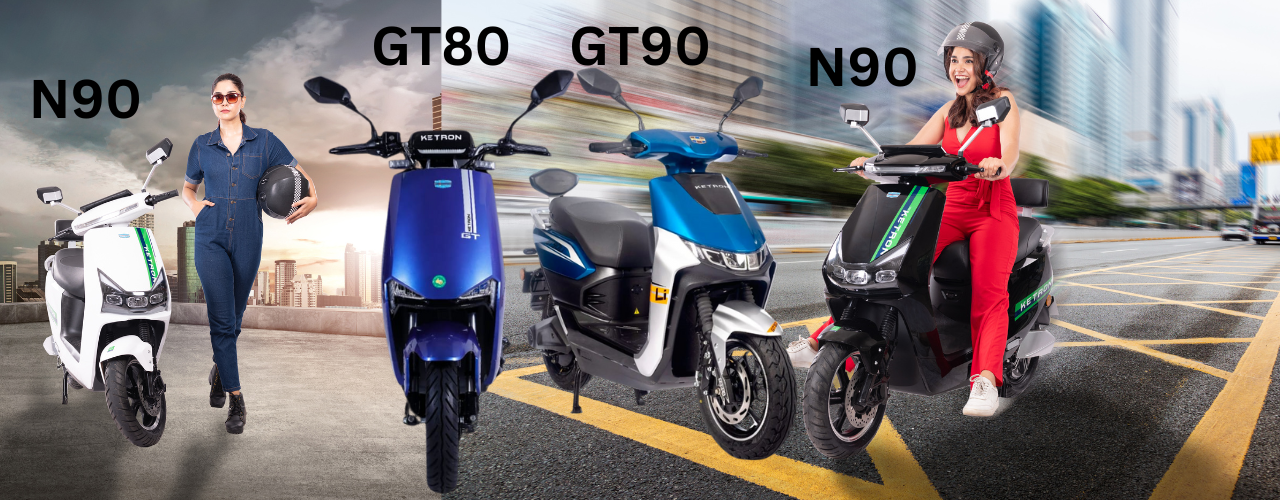
At Ketron, we believe in transparency. It’s time to separate fact from fiction and give you a proper reality check on what owning a GT-90VX or a GT-80R actually looks like.
Myth 1: “EV batteries wear out in a year or two.”
The Reality: This is perhaps the biggest misconception. While old lead-acid batteries had short lifespans, Ketron uses advanced Lithium-ion (Li-ion) technology.
- The Ketron Check: Our batteries are designed for longevity, typically lasting several years with thousands of charge cycles. We back this up with a robust 3-year warranty on our battery packs, ensuring your investment is protected for the long haul.
Myth 2: “Charging an EV is a slow, complicated hassle.”
The Reality: People often compare EV charging to a petrol pump visit, but the better comparison is your smartphone. You don’t stand and watch your phone charge; you plug it in while you sleep or work.
- The Ketron Check: Our scooters feature portable battery options and standard Indian three-pin plug compatibility. With a charging time of just 3–4 hours for a significant top-up, your Ketron is ready to go by the time you’ve finished your morning routine or a movie.
Myth 3: “Electric scooters aren’t powerful enough for Indian roads.”
The Reality: Skeptics often think “electric” means “slow.” In truth, electric motors provide instant torque. Unlike petrol engines that need to “rev up” to reach peak power, an EV gives you maximum pull the moment you twist the throttle.
- The Ketron Check: Whether it’s the GT-90VX or our commercial loaders, Ketron vehicles are engineered to handle flyovers, city slopes, and heavy pillion loads with ease, all while remaining whisper-quiet.
Myth 4: “You’ll get stranded if you run out of charge (Range Anxiety).”
The Reality: How far do you actually drive in a day? Statistics show the average urban commuter travels less than 30–40 km daily.
- The Ketron Check: With a real-world range of 80–100 km (and up to 140 km on specific models), a single charge can easily last 2–3 days for the average rider. Plus, our digital displays give you accurate, real-time battery percentages so there are never any surprises.
Myth 5: “EVs are more expensive than petrol scooters.”
The Reality: While the upfront “sticker price” might be slightly higher, the Total Cost of Ownership (TCO) is significantly lower.
- The Ketron Check: When you factor in that you are spending roughly 20 paise per km compared to ₹5 per km on petrol—plus the near-zero maintenance costs (no oil changes, no spark plugs, no engine tuning)—a Ketron EV typically pays for itself within the first 12–18 months of riding.
The Verdict
The “risks” of going electric are mostly things of the past. Today, choosing a Ketron EV is simply a logical decision for your wallet and a responsible one for the environment.
Still have doubts? Don’t take our word for it. Visit www.ketron.co to book a test ride and feel the difference for yourself. It’s time to leave the myths behind and join the revolution.